


Banana Pi Open Source Community has joined hands with Fortior Technology launch the BPI-VP10 low-voltage servo platform and build an open-source ecosystem for industrial servo systems.
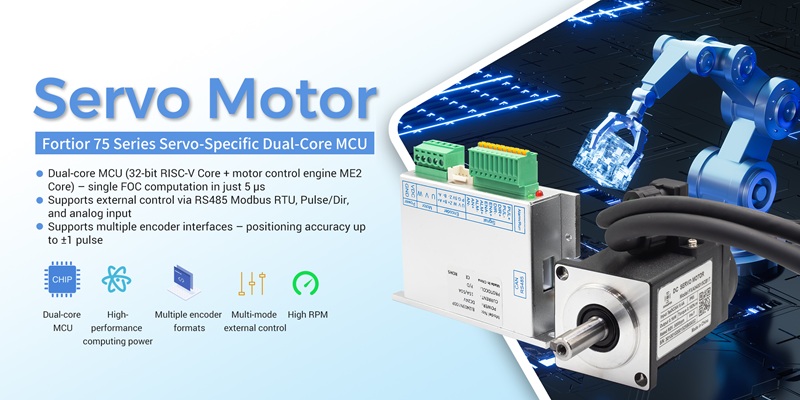
Banana Pi is pleased to announce the availability of the BPI-VP10 Open-Source Servo Motor Controller.
Developed jointly by the Banana Pi open-source community and the official of Fortior Technology(A Stock code:688279.SH; H Stock code: 1304.HK), the BPI-VP10 is powered by the FU7512L motor-control MCU, featuring a dual-core 32-bit RISC-V architecture and the ME2 motor control engine.
The controller supports hardware FOC, absolute encoders (Tamagawa/BiSS-C), incremental encoders, and Hall sensors, with pulse-direction input frequencies up to 4MHz. It is suitable for 100W/200W servo applications.
To support developers and system designers, Banana Pi provides open-source software, schematics, and development resources, helping accelerate innovation in industrial servo control systems.

Banana Pi BPI-VP10 is developed and designed based on Fortior Technology‘s FU7512L main controller MCU and FD6288Q pre-driver chip. The FU7512L is a dual-core MCU from Fortior’s 75 series, specifically engineered for servo applications; it integrates a 32-bit RISC-V core and the ME2 motor control engine. Capable of completing a single FOC calculation in just 5µs, it provides a powerful, low-latency computational foundation for current, speed, and position loop control.
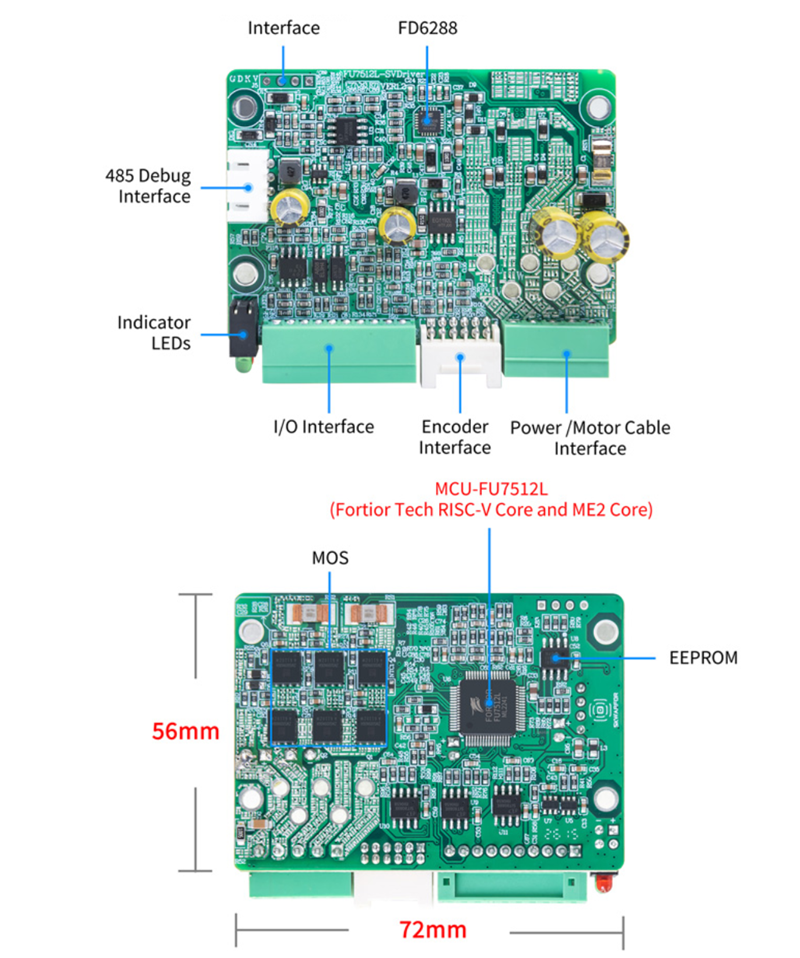
In terms of open source strategy, the platform adheres to the philosophy of “Core Transparency” and has simultaneously made public three major categories of key assets in the Banana Pi community:
Firmware source code is fully open sourced, including the servo control algorithms and the Modbus RTU protocol stack. The code is clearly structured and comes with explanatory software framework documentation, enabling developers to quickly become familiar with the system architecture.
Complete schematics are provided, clearly presenting the power stage, signal chain, and interface protection circuit designs. Developers can use these to understand the hardware architecture, as well as to adapt peripheral circuits and expand interfaces as needed.
A full toolchain is included. Ranging from servo motors and sheet metal enclosures to host computer debugging software and chip emulators, this rich accessory library not only allows developers to dive deep into self study but also offers the potential for rapid product deployment.
With this set of open assets, users are free to review and modify the entire system at will, truly achieving in depth mastery of the underlying control logic—so that they “know not only how it works, but also why it works that way.”
The BPI-VP10 covers 100W / 200W power ratings, offering a cost effective choice for low to medium power servo applications:

Powered by Fortior‘s self-developed dual-core MCU FU7512L (RISC-V Core + ME2 Core), with hardware-accelerated vector operations, achieving a single FOC control cycle of just 5 µs for ultra-high real-time responsiveness.
Simultaneously supports three control modes: pulse + direction, analog (0–10V), and RS485 (Modbus-RTU), enabling seamless integration with traditional PLCs, direct speed regulation, or multi-axis networked control.
Supports absolute encoders (Tamagawa/BiSS-C protocols), incremental encoders, and Hall-effect encoders, with positioning accuracy as high as ±1 pulse. A single driver board covers a wide range of applications—from basic speed regulation to high-precision absolute positioning.
Supports rated current of 15 Arms, peak current up to 50 Arms, and maximum speed up to 6000 rpm, reliably handling diverse dynamic load conditions.
The Banana Pi BPI VP10 is licensed under the BSD 3 Clause open source license, bringing tangible benefits to diverse user groups:Enterprise developers can directly integrate the platform as a ready to use driver core into their own equipment, significantly shortening R&D cycles and reducing upfront costs;Deep customizers are free to modify algorithms and interfaces to create differentiated products;Equipment manufacturers gain access to complete technical documentation, fundamentally avoiding supply chain dependency risks and ensuring long term maintainability.
The open source nature of the BPI VP10 goes far beyond mere disclosure of materials. The release of this platform marks the first step taken by Fortior Technology and Banana Pi toward building a vibrant technical ecosystem. By integrating self developed chips into transparent, reusable reference designs, both parties expect every community developer to continuously provide feedback and contributions through real world applications, jointly fostering a healthy technical ecosystem around Fortior’s chips. This will truly drive the proliferation of motor control solutions that are “easy to use, easy to adopt, and reliable to deploy” in industrial settings.
Currently, the BPI VP10 development kit is officially available for sale through Banana Pi’s official channels and Fortior’s authorized distributors. Looking ahead, through close collaboration between the Banana Pi open source community and Fortior Technology, a series of additional open source models will be launched


 Skype
Skype Tencent QQ
 Mail
Mail